Generative Engine Optimization (GEO): The New SEO for AI Search by Sahil Khan on September 22, 2026 179 views
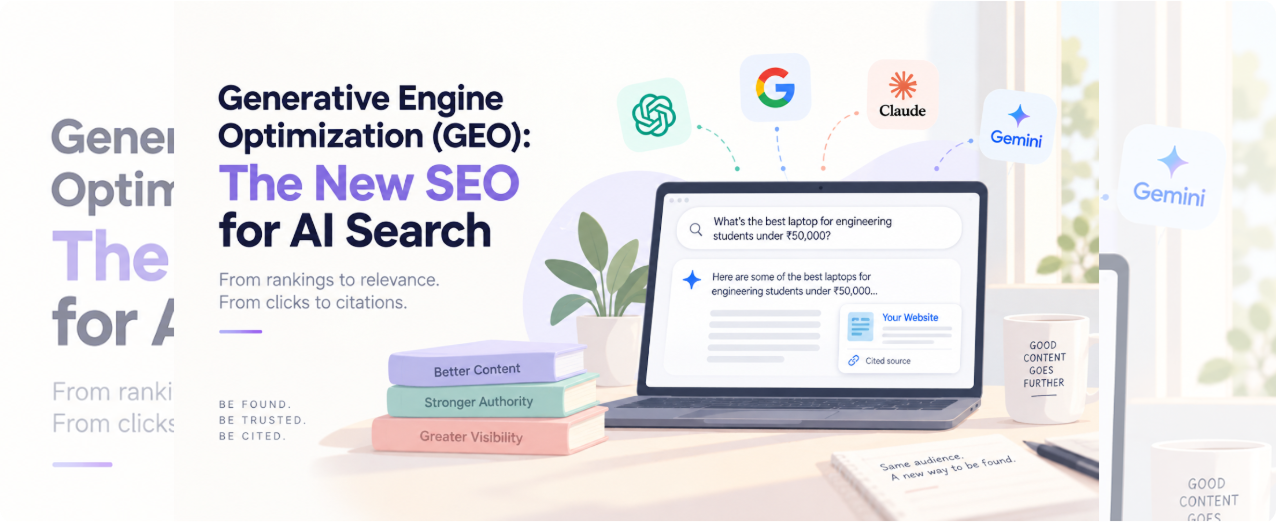
Search Is Changing Faster Than Most Businesses Realize
Imagine spending months ranking #1 on Google only to discover your audience never visits your website.
They ask ChatGPT, Gemini, or Google’s AI Overviews a question and receive an answer instantly.
The critical question is no longer “Can you rank?”, it’s “Will AI systems mention you when they answer?”
What Does This Mean for Businesses?
Recent industry field studies show that the rollout of Google’s AI Overviews is driving a sharp rise in “zero-click” searches. When AI answers a query directly at the top of the page, users frequently find what they need without clicking through to external websites—fundamentally altering organic traffic patterns.
Source: Search Engine Journal, “AI Overviews Cut Organic Clicks 38%, Field Study Finds”
While rankings still matter, AI-generated answers are shifting visibility from clicks alone to whether your content is cited and referenced.
This shift has created a new optimization challenge: Generative Engine Optimization (GEO).
What is GEO?
Generative Engine Optimization (GEO) is the process of increasing the likelihood that AI systems retrieve, understand, trust, and reference your content when answering user questions.
Think of it this way:
Traditional SEO was about convincing a search engine that your website deserved to be shown to users.
GEO is about ensuring AI systems recognize your content as authoritative enough to be included in their answers.
While SEO optimizes for rankings, GEO optimizes for citations, mentions, and inclusion in AI-generated responses.
The GEO Framework
GEO can be viewed as a three-part system:
- Discoverability – AI systems can find your content.
- Credibility – AI systems trust your content.
- Extractability – AI systems can easily understand and use your content.
Content must be found, trusted, and easily understood before AI systems can reference it in their answers.
Why GEO Matters
Search behavior is becoming more conversational and context-rich.
For years, users searched with short, fragmented keywords:
“Best laptop under ₹50,000”
Today, they increasingly ask complete questions:
“I’m a software engineering student in India. Which laptop under ₹50,000 is good for coding, light gaming, and battery life?”
This shift matters because AI-powered search experiences don’t simply return a list of links. Instead, they analyze information from multiple sources, identify the most relevant insights, and generate a direct answer.
To decide which sources to use, AI systems look for content that clearly addresses user intent.
For example:
Generic content:
Best laptops under ₹50,000 in 2025
AI-friendly content:
Comparing HP, Lenovo, and ASUS laptops under ₹50,000 based on coding performance, battery life, gaming capability, portability, and long-term value for engineering students.
The second example provides richer context and clearer relationships between entities, making it more useful for both users and AI systems.
In other words, it’s no longer just about being found. It’s about becoming a source AI considers worth referencing.
GEO vs. Traditional SEO
While they share some common principles, the goals of SEO and GEO are fundamentally different.
| Feature | Traditional SEO | Generative Engine Optimization (GEO) |
|---|---|---|
| Target Audience | Search Engine Ranking Algorithms & Human Searchers | AI-powered search and generative answer systems |
| Primary Outcome | Clicks and Organic Traffic | Citations, Mentions, and Inclusion in AI Responses |
| Strategy | Keywords, Backlinks, Meta Tags | Semantic Clarity, Entity Relationships, Trust |
| Focus | Ranking in Search Results | Becoming a Trusted Source for AI Systems |
Businesses don’t need to choose between SEO and GEO. The strongest strategy combines both.
How AI Systems Choose Sources
Although AI models vary, most systems evaluate content through similar signals:
1. Relevance
Does the content directly answer the user’s question?
2. Authority
Does the source demonstrate expertise through experience, data, references, or comprehensive coverage?
3. Extractability
Can key information be easily identified, summarized, and cited?
Content that performs well across all three areas is more likely to appear in AI-generated answers.
The GEO Playbook: How to Get AI to Notice You
If you want AI systems to recognize and reference your content, you need to rethink how information is created and structured.
1. Prioritize Structure and Clarity
Clear structure makes it easier for AI systems to identify and extract key information.
Do this:
- Use clear H2 and H3 headings
- Break content into logical sections
- Use bullet points where appropriate
- Include concise summaries and direct answers
- Add comparison tables when useful
The easier your content is to understand, the easier it becomes for AI systems to reference.
2. Cover Topics in Depth
AI systems are more likely to trust websites that demonstrate expertise across an entire topic rather than a single article.
If you want to establish authority in areas such as cloud security, data engineering, or AI, build an interconnected ecosystem of content that explores the subject from multiple angles.
Comprehensive topic coverage sends stronger expertise signals than isolated articles.
3. Become a Trustworthy Source
AI systems are more likely to use content that includes verifiable claims, expert insights, and references to authoritative sources.
The approach:
- Support claims with reliable data
- Reference reputable sources
- Include expert insights where possible
- Publish original observations or research
- Keep content accurate and up to date
Content that demonstrates expertise and reliability is more likely to be referenced.
4. Think in Entities, Not Just Keywords
Keywords still matter, but entities and context are becoming increasingly important.
An entity can be a technology, product, company, person, concept, or industry term.
Rather than repeating a keyword multiple times, focus on explaining relationships between concepts, technologies, business challenges, and solutions.
AI systems are increasingly designed to understand context and relationships, not just keyword frequency.
5. Answer Specific Questions
People interact with AI systems using natural language, which means content should be designed to answer real questions.
Look at the questions customers ask during:
- Sales calls
- Product evaluations
- Support interactions
- Discovery meetings
Creating content that directly addresses those questions increases the likelihood that AI systems will identify it as useful and relevant.
6. Strengthen Technical Signals
Content quality matters most, but technical signals still help.
Consider implementing:
- FAQ Schema
- Organization Schema
- Product Schema (where relevant)
- Author information
- Clear publication and update dates
These elements help search engines and AI systems better understand your content and its context.
Visibility Beyond Rankings
SEO isn’t going away anytime soon. Users will continue to visit websites, compare options, and consume content directly.
However, the definition of visibility is expanding.
Success is no longer measured solely by where you rank. Increasingly, it also depends on whether AI systems choose your content when generating answers.
Brands that optimize for both traditional search and AI-driven discovery will be better positioned as AI-powered search becomes a larger part of how people find information.
Final Thoughts
Generative Engine Optimization doesn’t replace SEO. It addresses a different challenge: how content gets discovered, interpreted, and cited by AI systems.
The organizations that succeed in this new environment won’t necessarily be the ones generating the most traffic. They’ll be the ones creating content that is clear, authoritative, trustworthy, and easy for AI systems to understand.
As AI-powered search continues to evolve, rankings will remain important.
But being cited may become just as valuable as being clicked.
About Author
