When Code Talks Business: Thinking Beyond Code by Istiyak Shabbir Vasiwala on June 4, 2026 532 views

When Code Talks Business: Thinking Beyond Code

Ever feel like you’re speaking a different language from the rest of the company? You know, you talk about APIs, microservices, and CI/CD, and they just nod and smile. Meanwhile, your product managers are talking about KPIs, ROI, and customer retention, and you just nod and smile.
As software developers, it’s easy to get caught up in the code. We love clean architecture, elegant solutions, and bugs that have no business being there. We’re excellent builders. But what if I told you that our true superpower isn’t just about building, it’s about building the right thing?
Let’s talk about making a mindset shift from a coder to a problem-solver.
🧠 The Mindset Shift: From “How?” to “Why?”
The biggest leap you can make is changing your core question from “Does my code work?” to “Does my code solve an actual problem?”
Think about it: you can write a perfectly functional, bug-free piece of code that adds no value to the business or the user. We’ve all been there. It’s like building a beautifully crafted hammer when the customer really needed a screwdriver.
To bridge this gap, you need to think beyond your IDE. You have to understand the “why” behind a feature request, not just the “how” to implement it.
🗣️ Speaking the Language of Business
Business leaders aren’t interested in the technical wizardry. They care about outcomes. They speak in terms of metrics and impact.
Instead of telling your boss you “optimized the API response time by 200 milliseconds,” try reframing it. Say you “reduced page load time, leading to a 10% decrease in cart abandonment and a direct increase in revenue.”
See the difference? You just turned a technical detail into a business win. Learn to speak their language: understand what a KPI (Key Performance Indicator) is, what ROI (Return on Investment) means, and what truly drives your customers.
🛠️ From Developer to Problem-Solver
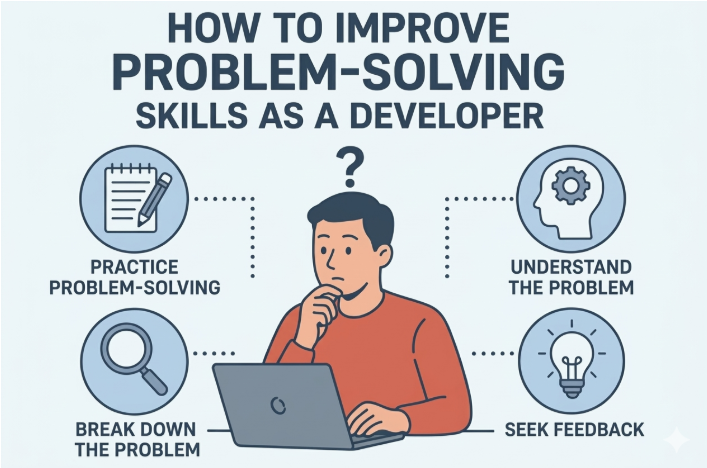
Your expertise in code gives you a unique advantage: you can spot inefficiencies and pain points that no one else can. Don’t just wait for a ticket to land in your queue. Actively look for ways to improve workflows, streamline processes, and enhance the user experience.
Case Study: A client asks for a simple field to generate a client code. Your first instinct is to jump straight into the code—INSERT INTO, new ClientCodeGenerator(), etc. But what if you paused and asked a few simple questions first?
- “How many people will use this?” (Answers if you need scalability.)
- “Should the code be unique?” (Answers if you need a specific database constraint.)
- “Does it need to be human-readable?” (Answers if you need a specific format or pattern.)
Asking these questions makes your implementation clearer and more precise. It saves you from building the wrong solution and from doing rework later.
By asking the right questions, you turn a simple task into a strategic action. You’re not just an implementer; you’re a product owner, a collaborator, and a problem-solver.
💡 Building Business Awareness

So, how do you learn this stuff? It’s easier than you think.
- Talk to people: Have a chat with your product manager. Ask your sales team about common customer objections. Listen to customer support calls to understand customer feedback and real user experiences.
- Look at the data: Dive into your company’s analytics. See where users are dropping off or getting stuck.
- Read widely: Follow blogs on product management, business strategy, and startups.
🚀 Why This Matters in Real Projects
This mindset is not just theory ; it has real impact in day-to-day development work.
When you focus on understanding the problem before writing code, you will notice several improvements:
- Reduces rework – Asking the right questions early prevents rebuilding the same feature again later.
- Improves client trust – Clients feel confident when developers think about their business, not just the code.
- Better architecture decisions – Knowing the real requirement helps you design scalable and cleaner solutions.
- Faster delivery – Clear understanding means fewer changes, fewer bugs, and quicker completion.
- Better communication – You can explain your work in terms of value, not just technical details.
In real projects, the developers who understand the business problem always stand out.
They don’t just complete tasks; they help move the product forward.
✅ Conclusion: Don’t Code, Think Impact.
Code is a powerful tool, but it’s only a means to an end. The real magic happens when you use your technical skills to solve a tangible business or user problem.
Your challenge: The next time you start a coding task, take five minutes to ask yourself, “How does this benefit the business or the user?”
Start small. The impact will be huge….Writing code makes you a developer, solving problems makes you an engineer, but solving business problems makes you impactful.
About Author